mark ericson
about
U
about
I am a computational designer, artist and educator whose work focuses the translation of historic modes of drawing into digital animations and images. This site contains a selection of work that encapsulates my research in the history of technical drawing and geometry. When we consider drawing and imaging in a digital context, it is often positioned as an extension of earlier pre-digital forms of description. Boundary representations, point clouds, meshes, and extended reality have all changed the means by which we image landscapes, objects, buildings and infrastructure. In these cases, questions surrounding digital representation have to do with the way in which new media can extend or otherwise further existing techniques through the powers of digital computation. My work considers another question: What can the technological limits of historical forms of representation offer to development of drawing with new media? This question is considered in each of the works contained in the Drawing Index of the site. I hold a Master's of Architecture from SCI_Arc.
ericson.mark.c@gmail.com
drawing index
2012 - 2017
Primitive Drawings
Nameless Curves
Euclid’s Wedge
Reassembling Guarini
Domestic Inversion

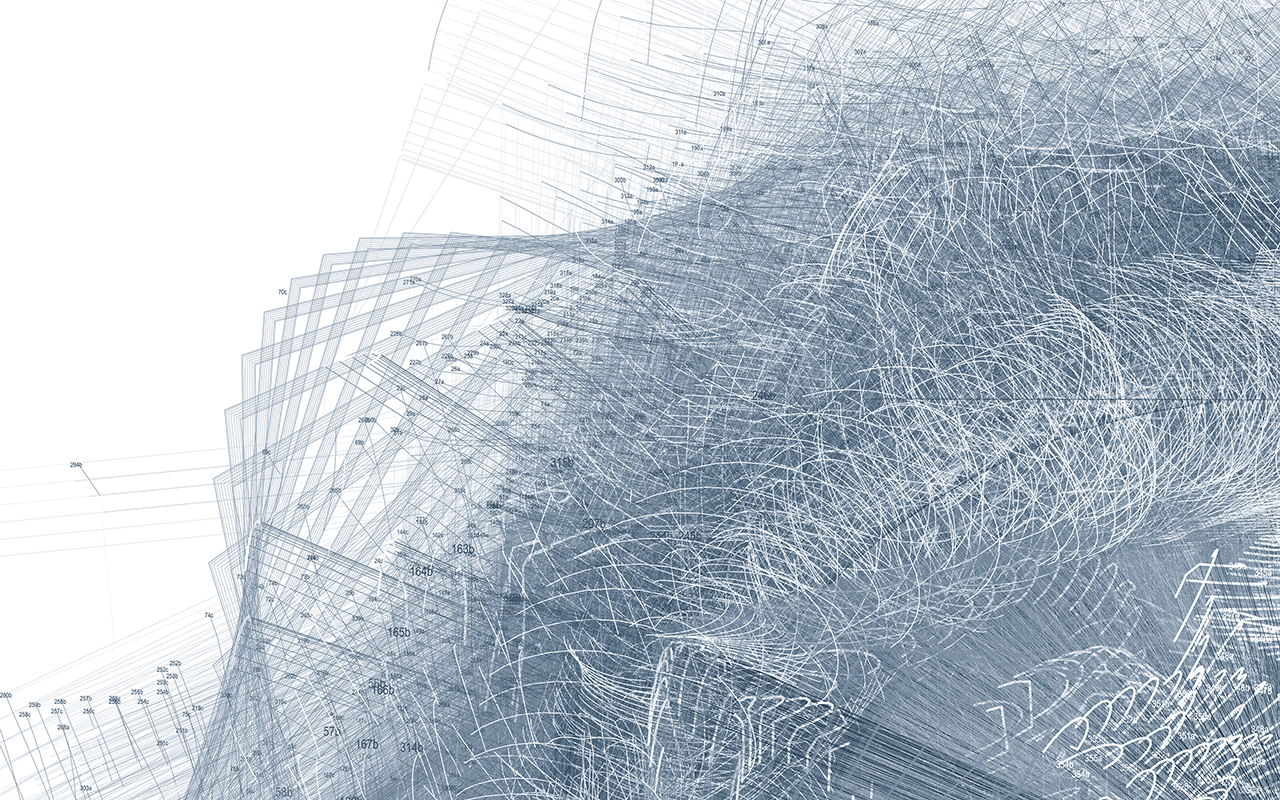


Animating Guarini
The animations and images contained here are translations and extensions of the drawing instructions provided by the Italian architect and mathematician, Guarino Guarini, in his posthumous treatise Architettura Civile(1735). The instructions have been translated into the programming language of Python to generate animations in the open source software Processing. The animations use a single color expressed in values of red, green, and blue, which are scaled across different lines within the drawing until they approach the value corresponding to white. Line weight corresponds to the conventions of descriptive geometry, in which object lines are thicker and construction lines are thinner. All lines are solid. All animation titles begin with, “The Two-Dimensional Orthographic Projection of a Semicircle,” and end with a description of the operation on each page: “Onto an Interrupted Epicycle of….” All titles are descriptions, and all animations are two-dimensional orthographic projections. The work from this research was published in Animating Guarini: An Orthographic Project by Applied Researcha and Design in July of 2020.
Drawing with Cones in Two Dimensions
A circle is a mathematical abstraction, and it cannot be materialized. This is a simple but also disconcerting statement. We have been exposed to drawing circles from the earliest moments of our education. As a term it is embedded in our language used to describe a variety of images, objects, and spaces. It is one of the most ordinary geometries. Nonetheless, we can neither draw nor build a circle. We can describe it as,Henri Poincare points out, by ratio of its radius and its circumference. We can also make a rough material approximation, a “round thing”, with a compass, a string, or a computer and a numerically controlled cutting device. In the construction of these “round things” the circle’s role is that of an instrument. The circle’s abstract geometric properties are used to define this new material thing that although it is round, is not a circle. In this instance the circle is an instrument, used to define new forms through its geometric properties.